Showing posts with label Teaching. Show all posts

Wednesday, 30 October 2013

Trialing times. Finding out more about English wine

Over the years I have been teaching winemaking at Plumpton College, I have slowly but surely been setting assessment tasks which can engage the students.  One of the assessments that I particularly enjoy setting is the vinification trials. Here year 2 students team-up to make wine that explores a set of vinification treatments using English grapes. They need to research the treatments, help design the trial, carryout the winemaking & analysis and then finally conduct a tasting of the trial wines with the class.

Muller Thurgau

This year we are investigating the following areas:
  • Protecting and enhancing aroma in Muller Thurgau wine using enzymes and yeast derivatives.
  • Examining the influence of maceration times on Dornfelder red wines
  • Investigating the role of yeast strain on Acolon Rose wine
  • Investigating new yeast strains on Reichensteiner white wine
  • Developing thiol aroma in Bacchus white wine
  • Assessing the impact of cold maceration and enzymes on Dornfelder red wines  

Acolon Rose yeast trial
Most of these trials are now underway, with just Reichensteiner to inoculate

Besides examining the impact of the treatments the students get a taste of managing wine ferments which include making correct additions, taking timely and accurate measurement as well as ameliorating potential problems such as hydrogen sulphide and volatile acidity.

Beside the vinification trials we also have a few student project wines being made.  So we also have trials underway that look at different vineyard planting densities of Regner vines, Non-sacchromyces in Pinot Noir to name a couple.
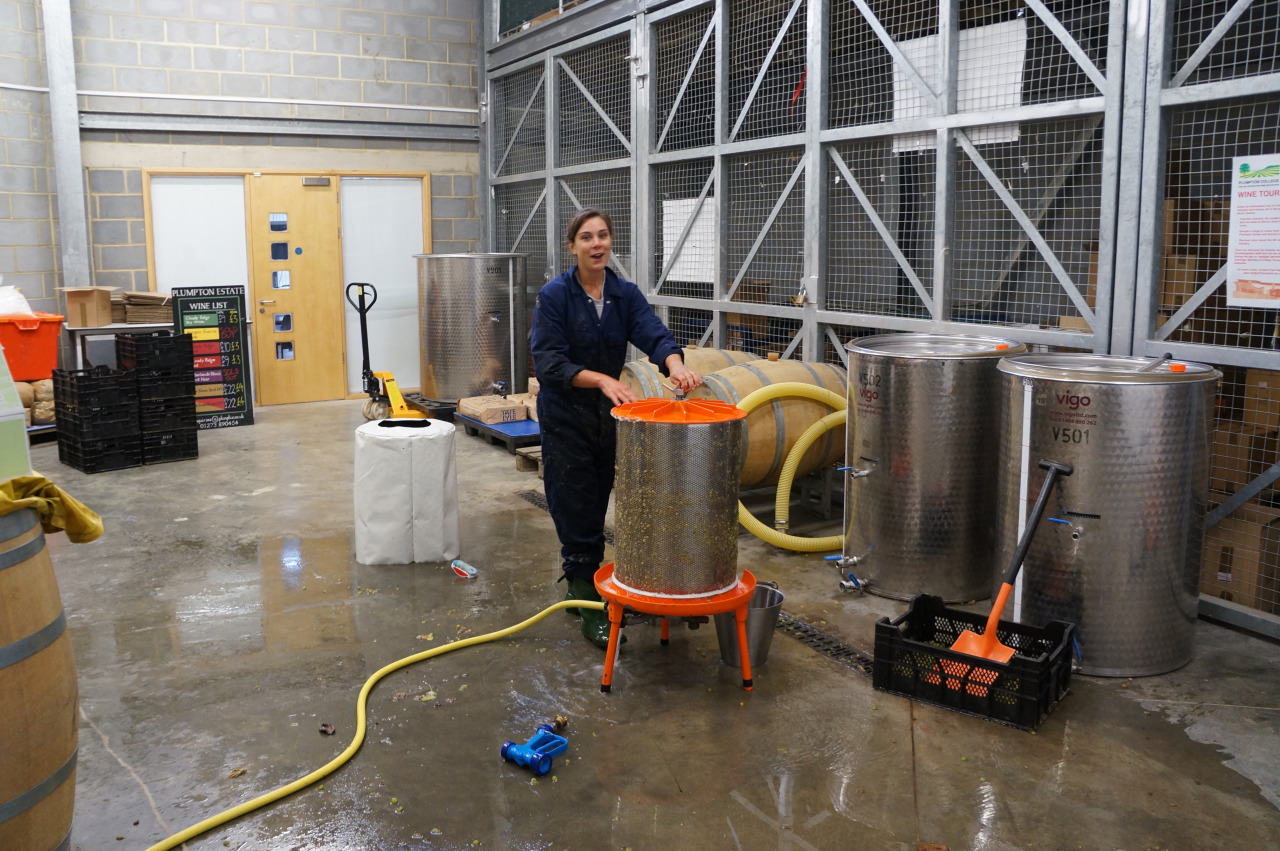

Pressing Regner planting density grapes
So the Rathfinny research winery is being well utilised, with students popping in and out all hours of the day and on weekends tending their ferments, and getting them used to the demands of a vintage.

Saturday, 19 October 2013

Off to Dijon!......"Do you have what it takes to be a world class sparkling wine judge?" part 2

Working at Plumpton College can be hard work, lectures to prepare, students to advise, assessments to set and mark. When I first start teaching, I naively though that after the long hours I had experienced as a winemaker I would now have a more normal "9-5" workload and consequently lots of free time. When the Principal of Plumpton College warned me that I would have to work hard, I smiled and said fine, sure in my belief that winemakers know plenty about hardwork.  I soon discovered I was wrong and the Principal was right.  Those first years of teaching were tough, lots of late nights, early mornings and weekend work. However I survived those years (helped by many therapeutic summer holidays in Italy to relax) and settled down with the teaching. However Plumpton College is dynamic environment and there is always something extra to be done. The course content and structure is always being revised to makes things better, there is always new staff to interact with offering new ideas & knowledge that make you re-evaluate what you know as well as new developments such as the new MSc in Viticulture & Oenology. Another thing that keeps us busy in student study trips and one I have been involved in is leading a group students to judge at the Effervescent du Monde sparkling wine competition.

To become a judge a Effervscent du Monde, you must participate in a training session, which was run yesterday. This year we extended the invitation to UK grape growers, wine makers and people in the wine trade. We had an excellent response and over 20 people participating in the training session.

The training is crucial, as the Effervscent du Monde are trying to improve accuracy and precision in its judges. This is very important with sparkling wines as they are more difficult to judge then still wines because they are very influenced by the way there are served.  This was highlighted in the lectures given by Professor Richard Marchal from the University of Reims, that showed that Mousse and Effervescence are influenced by many factors including shape and cleanliness of the glass, amount of wine poured, wine temperature and time from pouring. This in turn impacts wine aroma and flavour. Professor Marchal used this information to inform us how the wines should be served and importantly how the wines should be judged.


Professor Richard Marchal talking about Effervescence and foam

We also hosted Jean Claude Buffin, who discussed how the du Monde wine shows are conducted. The aim of the competition is to improve the accuracy and precision of the assessments.  He also discussed at great length howjudges may be influenced in the decisions they make and steps that can be taken to reduced this problem.


Part of the judging sheet for Effervescents du Monde


After this we participated in a series of tasting session to practice the judging system using a variety of sparkling wines including Champagne, Cava, Prosecco and of course English Sparkling wine. It wasn't long before the would-be judges got the hang of the new judging system and started to give some consistent results in their assessments.

You can also read Laura Clay's blog post on the day here

So now that training is over, its time to plan our trip to Dijon for the actual judging. Of course going to France and Burgundy means that the the trip can be enriched with some extra activities. On this years itinerary we hope to include the the following:


Cellars of Champagne Drappier
Hospice de Beaune Burgundy in barrel


I can't wait and if its a good as last years trip (read about here) it will be a great wine experience.

Sunday, 15 September 2013

Busy times

What a week!

Most of my time was spent lecturing to 17 students on the Principles of Winemaking course at Plumpton College. They were a great bunch, really enthusiastic and keen to find out as much about wine in a short amount of time.  As usual there was a real mix; permutations of women, men, all ages, British, Australians, Turkish, American, Taiwanese, Danish, career changers, newly retired,  business people, consultants, a microbiologist, a chemist, MW students and grape growers.  
Principles of winemaking students


In the week that I have with them I have 20 hours of lecturers to talk through the key concepts of winemaking, which is a tough ask.  Further more I don't want to give a simple recipe to follow, but instead want to give them some tools with which they can use to approach winemaking and allow them to make their own decisions.  Its a tough process and the students need to be engaged to be able to assimilate the knowledge.  Luckily they are very keen and up for the challenge.  After I have them for lectures they are then sent to winery to do more practical activities with our practical wine making instructor Peter Morgan.  This helps cement all the theory  they have covered.
Cleaning the crusher after the afternoon processing


When not teaching, I was getting ready for the return of our undergraduate students.  Re-enrolments start this week so its always a busy time.  There are new students to meet and  prepare for teaching as wall as our returning second years to welcome back.  Though in this case the welcome back is an intensive 2 day course on Winery safety, so that they can work in the College winery and labs without endangering themselves and others.  

But lets not stop there, I also have a second group of Principles of Winemaking students in for two days, a new piece of lab equipment (new Randox Monaco analyser) to install and plenty of the usual paperwork to complete.  Can't see myself working much on PhD this week, but lets see what happens.  Time to log off and plan some teaching and assessments.