Showing posts with label Research. Show all posts

Wednesday, 30 October 2013

Trialing times. Finding out more about English wine

Over the years I have been teaching winemaking at Plumpton College, I have slowly but surely been setting assessment tasks which can engage the students.  One of the assessments that I particularly enjoy setting is the vinification trials. Here year 2 students team-up to make wine that explores a set of vinification treatments using English grapes. They need to research the treatments, help design the trial, carryout the winemaking & analysis and then finally conduct a tasting of the trial wines with the class.

Muller Thurgau

This year we are investigating the following areas:
  • Protecting and enhancing aroma in Muller Thurgau wine using enzymes and yeast derivatives.
  • Examining the influence of maceration times on Dornfelder red wines
  • Investigating the role of yeast strain on Acolon Rose wine
  • Investigating new yeast strains on Reichensteiner white wine
  • Developing thiol aroma in Bacchus white wine
  • Assessing the impact of cold maceration and enzymes on Dornfelder red wines  

Acolon Rose yeast trial
Most of these trials are now underway, with just Reichensteiner to inoculate

Besides examining the impact of the treatments the students get a taste of managing wine ferments which include making correct additions, taking timely and accurate measurement as well as ameliorating potential problems such as hydrogen sulphide and volatile acidity.

Beside the vinification trials we also have a few student project wines being made.  So we also have trials underway that look at different vineyard planting densities of Regner vines, Non-sacchromyces in Pinot Noir to name a couple.


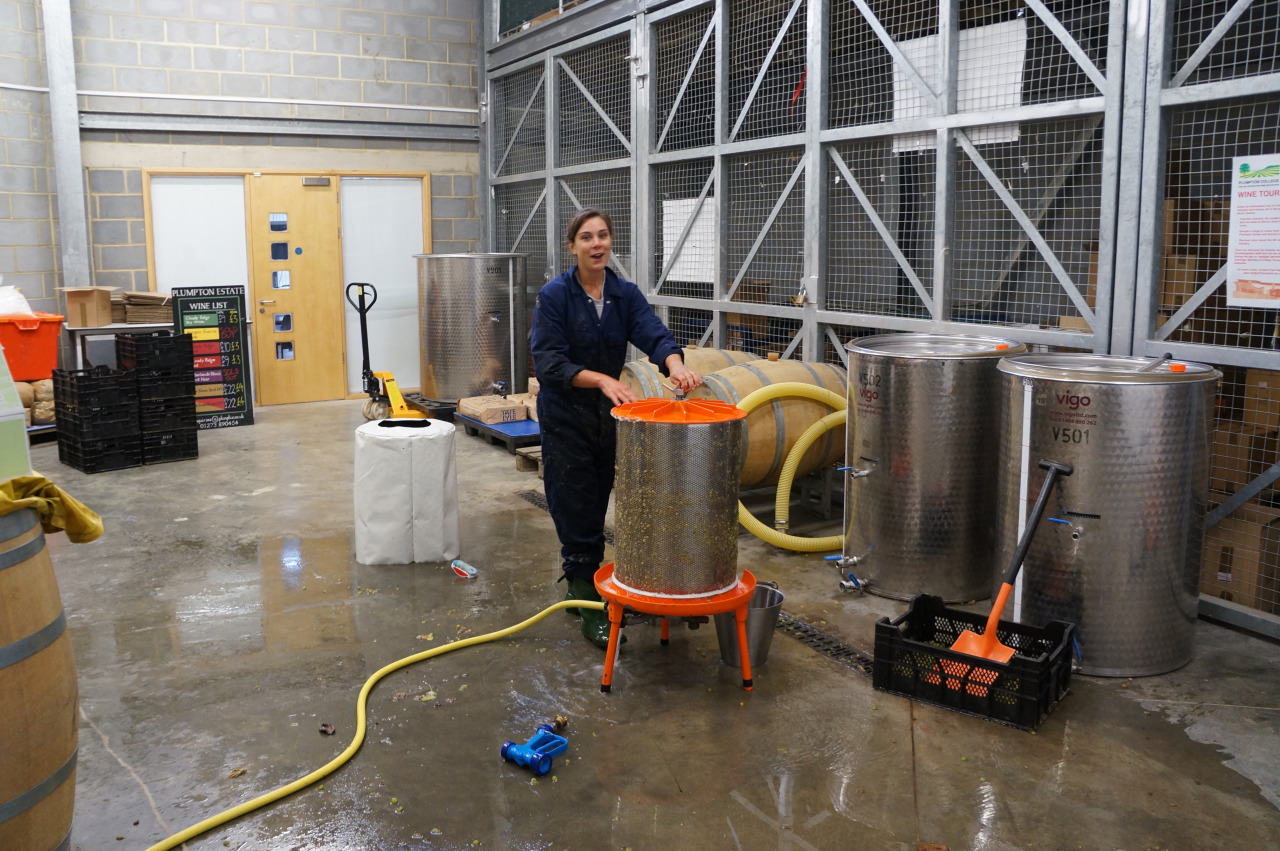
Pressing Regner planting density grapes
So the Rathfinny research winery is being well utilised, with students popping in and out all hours of the day and on weekends tending their ferments, and getting them used to the demands of a vintage.

Sunday, 29 September 2013

Syringaldazine and sparkling wine

Last week I was preparing for my trip to Champagne that is occurring this week. I will be working with my Colleagues from University of Reims, collecting samples during grape processing. We have had to wait until the CIVC had declared the Vendage dates for Champagne. So I will be going to France on Tuesday night and spending the rest of the week collecting juice samples from a large winery during the key stages of whole-bunch pressing.  Once we have collecting the samples, it will be back to the lab to carry-out key analysis, and then return the next day to collect more samples.

Generally most of France has being experiencing trying grape growing conditions such as late budburst, flooding rains, hail, scorching hot summers months and mostly recently weather conditions conducive to mildew and grey rot. Champagne has not been immune to this problems, and some vineyards are showing a proportion of Botrytis cinerea infection. I will be quantifying how much Laccase or by its technical name benzenediol:oxygen oxidoreductase  (IUBMB Enzyme Nomenclature E.C. 1.10.3.2) has been produced by the infection. One of these easiest ways to quantify the quantity of enzymes is to measure the substrates consumed or the by-products produced.

In my experiments I will be measuring how much Syringaldazine (4-Hydroxy-3,5-dimethoxybenzaldehyde azine) has been consumed per minute of activity.  


Syringaldazine (courtesy of Sigma Aldrich)

They are many methods for measuring this consumption, at different pH, temperature, concentration and buffers.

  • Consumption of 0.5 mM syringaldazine at pH 6.5 and 25 °C (Lante et al. 2000)
  • Consumption of 1.0 mM syringaldazine in citrate-phosphate buffer at pH 5.0 (Minussi et al. 2007)
  • Consumption of 0.216 mM syringaldazine in potassium phosphate buffer at pH 6.5 and 37 °C (McNaughton 2003)
  •  Consumption of 0.01% w/v syringaldazine in sodium acetate buffer (Iland et al. 2004)

The reason syringaldazine is used because it oxidises quickly and produces a distinctive red/magenta colour change at 525-530 nm, which can be measured by visible light spectrophotometer. The increase absorbency at 525/530 can then be related to the amount of syringaldzine consumed and thence the activity of laccase in the sample.


Cuvettes of syringaldzine reaction product


Iland, P., Bruer, N., Edwards, G., et al., 2004. Chemical analysis of grapes and wine: techniques and concepts, Campbelltown: Patrick Iland wine promotions.
Lante, A. et al., 2000. Biodegradation of phenols by laccase immobilised in a membrane reactor. Process Biochemistry, 36(1-2), pp.51–58. Available at: http://linkinghub.elsevier.com/retrieve/pii/S0032959200001801.
McNaughton, G., 2003. Enzymatic assay of laccasse EC 1.10.3.2. Sigma aldrich technical documents. Available at: http://www.sigmaaldrich.com/technical-documents/protocols/biology/enzymatic-assay-of-laccase.html [Accessed September 8, 2013].
Minussi, R.C. et al., 2007. Phenols removal in musts: Strategy for wine stabilization by laccase. Journal of Molecular Catalysis B: Enzymatic, 45(3-4), pp.102–107. Available at: http://linkinghub.elsevier.com/retrieve/pii/S1381117706003444 [Accessed September 4, 2013].


Tuesday, 17 September 2013

Jack Ward laboratory at Plumpton College


A tweet by  Dr Belinda Kemp an ex-Plumpton student and more recently ex-lecturer who is now senior scientist at CCOVI Brock University, led me to a recent paper about English & Welsh Winemaking.  In Hugh Clout's article, he outlines some of the important history of the local wine industry.  It makes mention of Jack Ward and the Merrydown drinks company and the important role they played in bring viticulture/oenology back to Britain after it had died out in the early 20th Century.

Fast forward to September 2013 and the Plumpton College wine department is about to expand into its new wing.  The new building has been under construction for just over a year, and will incorporate two significant spaces.  The first is the Rathfinny research winery, a new micro-vinification facility for conducting trials by students and researchers.  This new area was funded by generous donations from Sarah & Mark Driver of Rathfinny Estate, who also gets a mention in Hugh's article.


Rathfinny research winery 

The second area is a newly expanded laboratory for teaching and research, which was made possible by a donation from the Merrydown trust.  This laboratory will be named the Jack Ward laboratory to honour his contribution.


Jack Ward laboratory
Along with these new additions, the changes inspired by the construction have also allowed some additional expansion to the HE student area of the College.  So our students will soon be benefiting from a larger common room, group study rooms and enlarged computer suite.


New HE Computing suite


So the HE students will be here shortly and they will get to study in this area that links to the past with the future, which has all be made possible through the generosity of their predecessors.    

For more information on the project, as well as information how you can assist please go to the Plumpton College Wine Research Centre homepage